
curator: Basak Senova
artists: Alet Pretorius, Atul Bhalla, Barbara Putz Plecko, Christophe Fellay, Diana Vives & Douglas Gimberg, Diego Masera, Ebru Kurbak, Egle Oddo, Eugenie Touze, Francesco Bellina, Hera Buyuktasciyan, Herrana Addisu, Inma Herrera, Isa Rosenberger, Jessica Ostrowicz, Johan Thom, Ledelle Moe, Lundahl & Seitl, Mithu Sen, Robin Rhode, Rojda Tugrul, Senzo Masondo, Seretse Moletsane, The Centre for the Less Good Idea, Tshepiso Mahooe, The ZoNE, The Sediment Project
venue: Art Rooms, ARUCAD Kyrenia Campus and ARUCAD Nicosia Bandabuliya Campus
coordinates: Kyrenia and Nicosia, Cyprus, 2026
website: https://www.artroomsatthehouse.com/
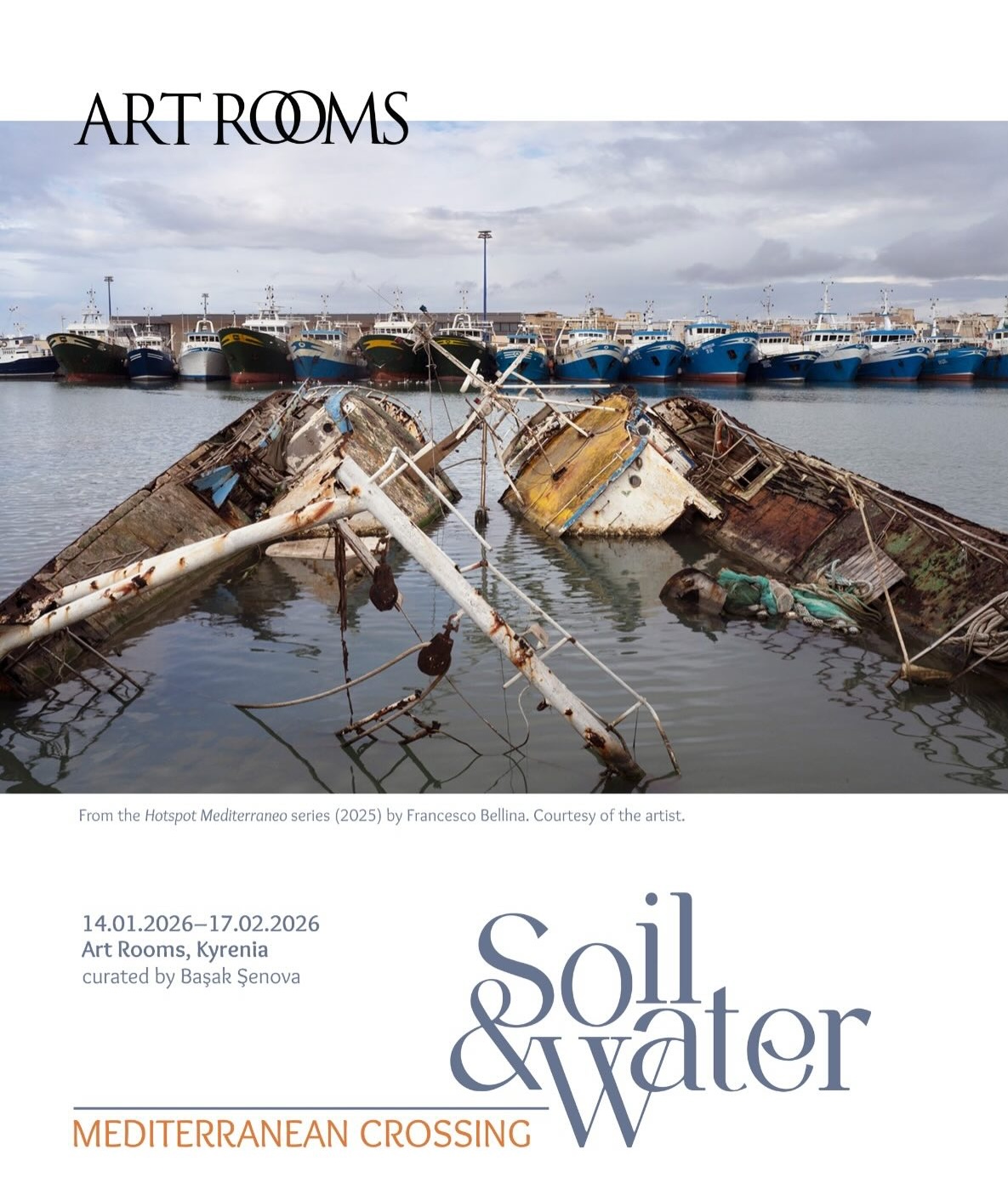
SOIL & WATER: MEDITERRANEAN CROSSING brings together international artists who treat soil and water not as neutral resources but as material, ecological, cultural, and political agents. Across sculpture, performance, and research-based practices, soil and water emerge as forces that shape landscapes, environments, and histories, carrying memory and lived experience. Situated in the Mediterranean, a region shaped by centuries of crossings, exchanges, extraction, and conflict, the exhibition situates these explorations in a new context while connecting to the ongoing international SOIL & WATER research project.
Developed collaboratively by Prof. Johan Thom (University of Pretoria) and Assoc. Prof. Dr Basak Senova (University of Applied Arts Vienna), in partnership with the NIROX Foundation, the SOIL & WATER project was initiated in South Africa in response to concerns about the pollution of rivers and groundwater in the Cradle of Humankind, a UNESCO World Heritage Site. The project insists that art must do more than illustrate ecological facts. It must generate meaning, urgency, and critical reflection. Across its evolving manifestations, Soil & Water approaches soil and water as active agents that store and release, conceal and reveal, preserve and transform, carrying time, memory, ideology, and history. The project also reflects on soil and water as shared yet unevenly governed resources, highlighting the ecological, social, and political pressures that shape them. Therefore, the artistic practices presented draw attention to sedimented histories, material processes, and fragile futures, inviting audiences to reconsider their relationship to the environments they inhabit. By extending this research into the Mediterranean context, the project further examines how the dynamic interplay between soil and water sustains ecosystems while simultaneously exposing the political, social, and environmental pressures placed upon them.
While the exhibition is anchored at Art Rooms, select works extend onto the ARUCAD campus, creating a dialogue between gallery and academic spaces. For instance, following her residency in Cyprus in December, South African artist Ledelle Moe produced a large-scale sculptural work installed on the ARUCAD campus, while her preparatory drawings and the making of a video are presented within the exhibition at Art Rooms, tracing the material and conceptual processes behind the work. Some works are also making bridges between the exhibition at the Nirox Sculpture and Soil & Water: Mediterranean Crossing.
Soil & Water is a collaborative project developed by the University of Pretoria and the NIROX Foundation and Sculpture Park. The project is supported by the NIROX Foundation, University of Pretoria, Arts Promotion Centre Finland, Art Rooms Kyrenia, ARUCAD Arkin University of Creative Arts and Design, Austrian Cultural Forum Pretoria, BIENALSUR Bienal Internacional de Arte Contemporáneo del Sur, BMKÖS Austrian Ministry of Arts, Culture, Civil Service and Sport, Danish Arts Foundation, Embassy of Austria in South Africa, Embassy of Spain in South Africa, The Finnish Cultural Foundation, IASPIS International Programme for Visual and Applied Arts, Italian Cultural Institute of Pretoria, SKF Support Art and Research, KKP Art and Communication Practices, University of Applied Arts Vienna, Kunsthaus Dahlem Berlin, L’Accolade Foundation Paris, The Claire and Edoardo Villa Will Trust South Africa, Ukrainian Institute, and Techizart Istanbul.


